










Automatic Watches

from: Sinan Hayik, watch expert
Discover the fascination of mechanical watch movements. An automatic watch is a mechanical timepiece that does not require a battery. Instead, it winds itself through the natural movement of your wrist as you wear it. It combines fascinating mechanics with distinctive design.
But how does automatic winding work? How long can an automatic watch run without being worn, and what advantages does it offer over a quartz watch?
Learn more about how automatic watches work and what makes them special, and explore the CASIO automatic watches and their technical features.
Automatic Watches: Everything you need to know
Table of contents
- What is an Automatic Watch?
- How does an Automatic Watch work?
- Do Automatic Watches have a battery?
- Do you need to wind an Automatic Watch?
- How long does an Automatic Watch run without being worn?
- What are the advantages of an Automatic Watch?
- Automatic vs. Quartz watches: What's the difference?
- Which Automatic Watches does CASIO offer?
What is an Automatic Watch?
An automatic watch is a mechanical timepiece that does not require a battery. Inside the watch, a rotor converts the movement of your wrist into energy. This energy is stored in the mainspring, which powers the mechanical watch movement. If the watch is not worn for an extended period, the stored energy eventually runs out and the watch stops.
What is the difference between an automatic watch and a mechanical watch? An automatic watch is essentially a type of mechanical watch. The term "mechanical" describes the type of movement, while "automatic" refers to the winding mechanism. Mechanical watches can therefore be divided into two types: automatic watches and manual-winding watches. An automatic watch is wound by the movement of your wrist, whereas a manual-winding watch must be wound by hand using the crown.
In short: Every automatic watch is a mechanical watch, but not every mechanical watch is an automatic watch.
How does an Automatic Watch work?
An automatic watch uses the movement of your wrist to generate energy for its mechanical movement. This is why an automatic watch does not require a battery: As you wear it, a rotor inside the watch moves and winds the mainspring through the automatic winding mechanism.
The mainspring stores the energy generated and releases it in a controlled way to power the mechanical movement. The gear train then transfers this energy to the hands. The escapement and balance wheel regulate the release of energy, ensuring that the watch keeps time consistently.
The process can be illustrated in simplified form as follows:
Movement of the wrist → Rotor → Automatic winding mechanism → Mainspring → Gear train → Escapement and balance wheel → Hands
A mechanical watch without a battery generally works on a similar principle of energy storage. The difference is that in an automatic watch, the rotor winds the mainspring automatically, whereas a manual-winding watch must be wound regularly by hand using the crown.
CASIO automatic watches also use this traditional mechanical technology. The automatic winding mechanism harnesses the movement of your wrist to power the mechanical movement.
Do Automatic Watches have a battery?
No, automatic watches do not have a battery. They are powered entirely by mechanically stored energy, rather than an electrical power source.
This means an automatic watch does not require an electrical power source. When worn regularly, it keeps running through its automatic winding mechanism. If it is not worn for an extended period, it may stop once the stored energy runs out.
Manual-winding mechanical watches also work without a battery. However, the energy they need is supplied manually by winding the crown.
Do you need to wind an Automatic Watch?
An automatic watch generally does not need to be wound by hand when worn regularly. The movement of your wrist automatically winds the watch and supplies it with energy. This means that manual winding is usually not necessary if you wear your automatic watch frequently.
However, if the watch is not worn for an extended period, its power reserve may run out. The automatic watch will then stop and needs to be restarted. Depending on the movement, this can be done either by wearing the watch again or winding it manually using the crown.
Many automatic movements can also be wound by hand when needed. How to wind an automatic watch manually and how long it runs without being worn depend on the specific movement and its power reserve.
How long does an Automatic Watch run without being worn?
The amount of time an automatic watch continues to run after being fully wound, without any further movement, is known as its power reserve.
How long the power reserve lasts depends on the individual watch movement. CASIO automatic watches, for example, can offer a power reserve of 40 to 50 hours.
Once the power reserve runs out, the watch stops. Depending on the model, it can then easily be wound clockwise using the crown or restarted by wearing it again.
What are the advantages of an Automatic Watch?
An automatic watch combines traditional watchmaking craftsmanship with practical technology and a unique wearing experience. But what makes it stand out from other types of watches?
No battery required: An automatic watch is powered by a mechanical movement. A rotor uses the movement of your wrist to wind the mainspring. This allows the watch to run without a battery, making it an ideal choice for those who prefer a watch that does not require one.Effortless winding for everyday wear: When you wear your automatic watch regularly, your natural movements keep it wound automatically. This means you generally do not need to wind it by hand every day.
Precision engineering and lasting quality: A mechanical watch contains numerous precision-engineered components working together. Models with a transparent case back allow you to admire the movement at work. With proper care and regular servicing, a high-quality automatic watch can last for many years.
Distinctive style: Mechanical wristwatches combine technical sophistication with timeless design. Whether sporty or elegant, an automatic watch is more than just a timepiece. It appeals especially to those who appreciate the art of traditional watchmaking.
Automatic vs. Quartz watches: What's the difference?
The main difference between an automatic watch and a quartz watch lies in their movements and power sources. An automatic watch is a mechanical timepiece that does not require a battery. Instead, it gets its energy from a mainspring, which is wound by the movement of your wrist. Automatic watches appeal to those who appreciate intricate mechanics, traditional watchmaking craftsmanship and distinctive character. A quartz watch, on the other hand, uses a vibrating quartz crystal to keep time and is usually powered by a battery. Its main advantages are high timekeeping accuracy and ease of use.
Automatic vs. Quartz watches: A comparison
Feature Automatic watch Quartz watch Movement Mechanical movement with precisely engineered components Electronic quartz movement Power source No battery required; powered by the movement of your wrist Usually battery-powered; solar watches use light energy Timekeeping accuracy Mechanical timekeeping with some variation in accuracy Generally offers very high accuracy Winding Automatic winding through wrist movement; extra manual winding also possible, depending on the model No winding required When not worn Stops once the power reserve runs out Continues running as long as its power source provides sufficient energy Maintenance Regular servicing of the mechanical movement is recommended Generally needs less maintenance; battery replacement may be necessary Key Advantages Battery-free operation, intricate mechanics and traditional watchmaking craftsmanship High timekeeping accuracy and ease of use Which Automatic Watches does CASIO offer?
Looking for an automatic watch that combines traditional watchmaking craftsmanship with distinctive design? CASIO automatic watches combine mechanical movements with striking dials, quality materials and carefully considered technical details. Explore the different CASIO collections and discover automatic watches that stand out for their features, design and functionality.
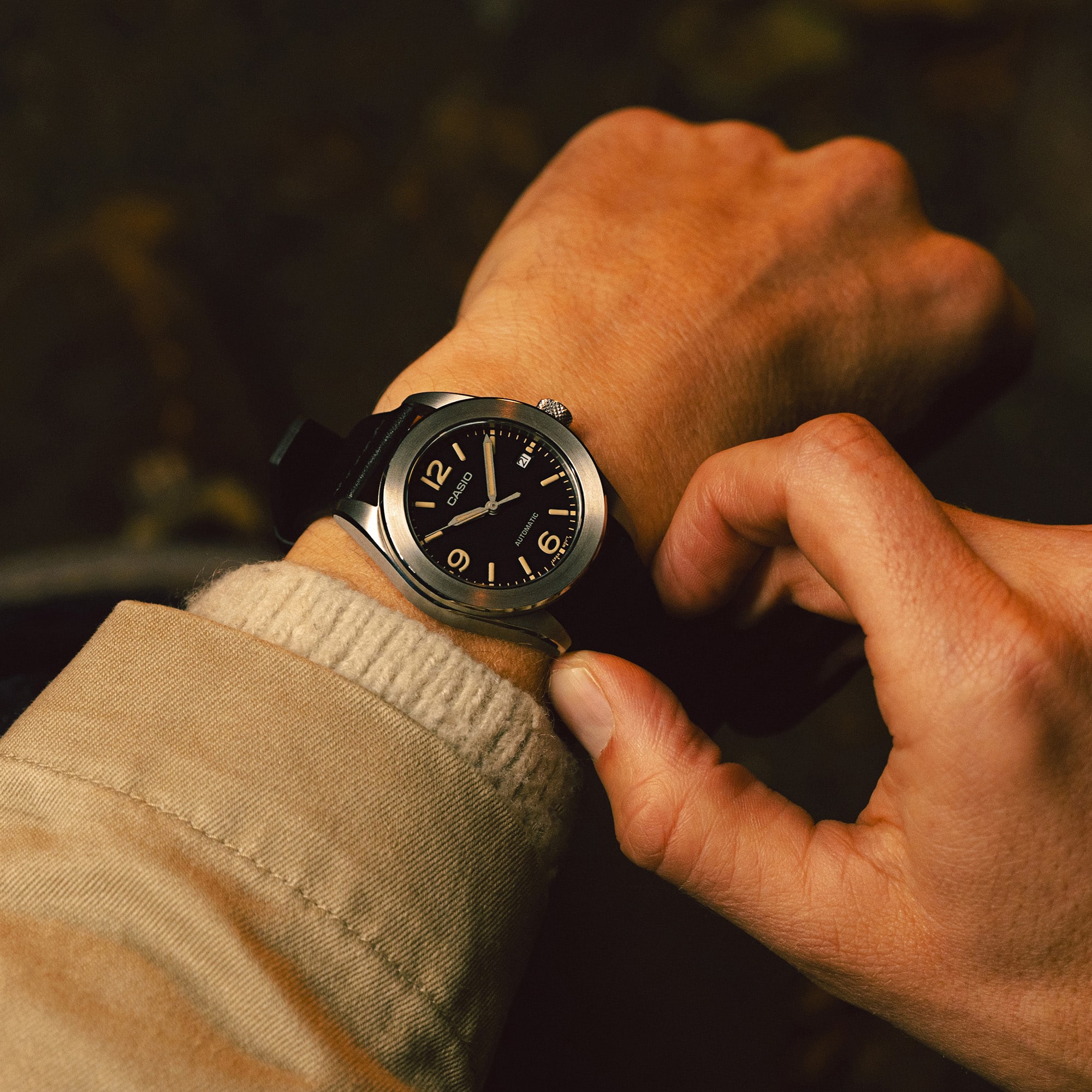
1. CASIO CMK-100
The CASIO CMK-100 is an automatic watch for both men and women, combining the mechanics of an automatic movement with the functional design of a field watch. Its lightweight titanium case, textured dial and distinctive hour markers define its characteristic look while ensuring excellent legibility. Inside, a Japan-made automatic movement with magnetic resistance provides a power reserve of approximately 42 hours. Sapphire crystal protects the dial, while water resistance up to 10 bar makes the watch suitable for outdoor activities. Depending on the model, the CMK-100 is available with a titanium, textile or leather strap.
Movement: Automatic winding with additional manual winding and magnetic resistance
Power Reserve: Approx. 42 hours
Case Size: 44.7 × 38 × 11.4 mm
Crystal: Scratch-resistant sapphire crystal
Case Material: Lightweight titanium case with ion plating and titanium carbide (TiC) coating
Dial: Textured surface with luminous hour markers
Strap: Depending on the model, titanium, textile or vegetable-tanned leather from Tuscany
Water Resistance: Up to 10 bar
Accuracy: −20 to +40 seconds per day
Additional Features: Date display, stop-seconds function and analogue three-hand display
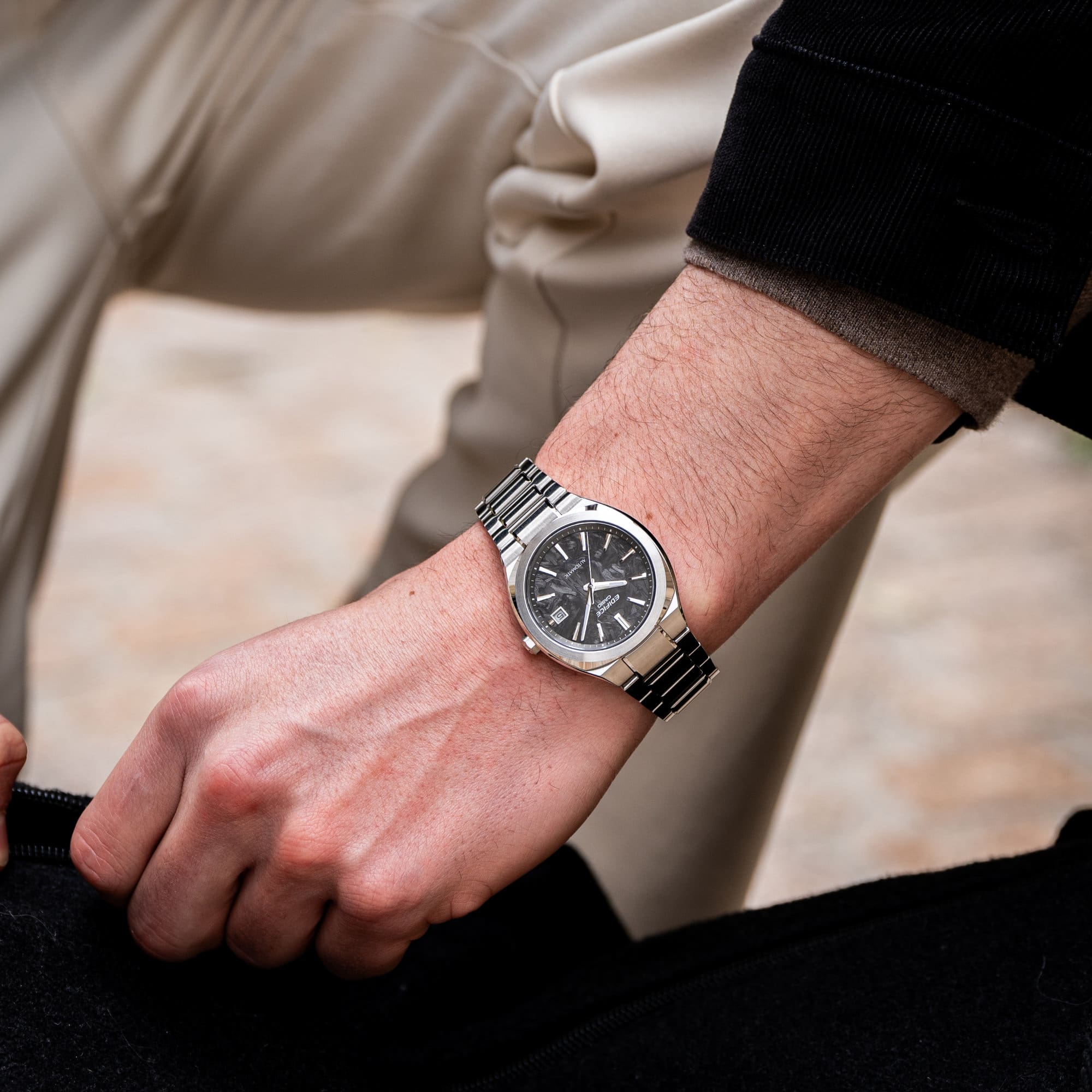
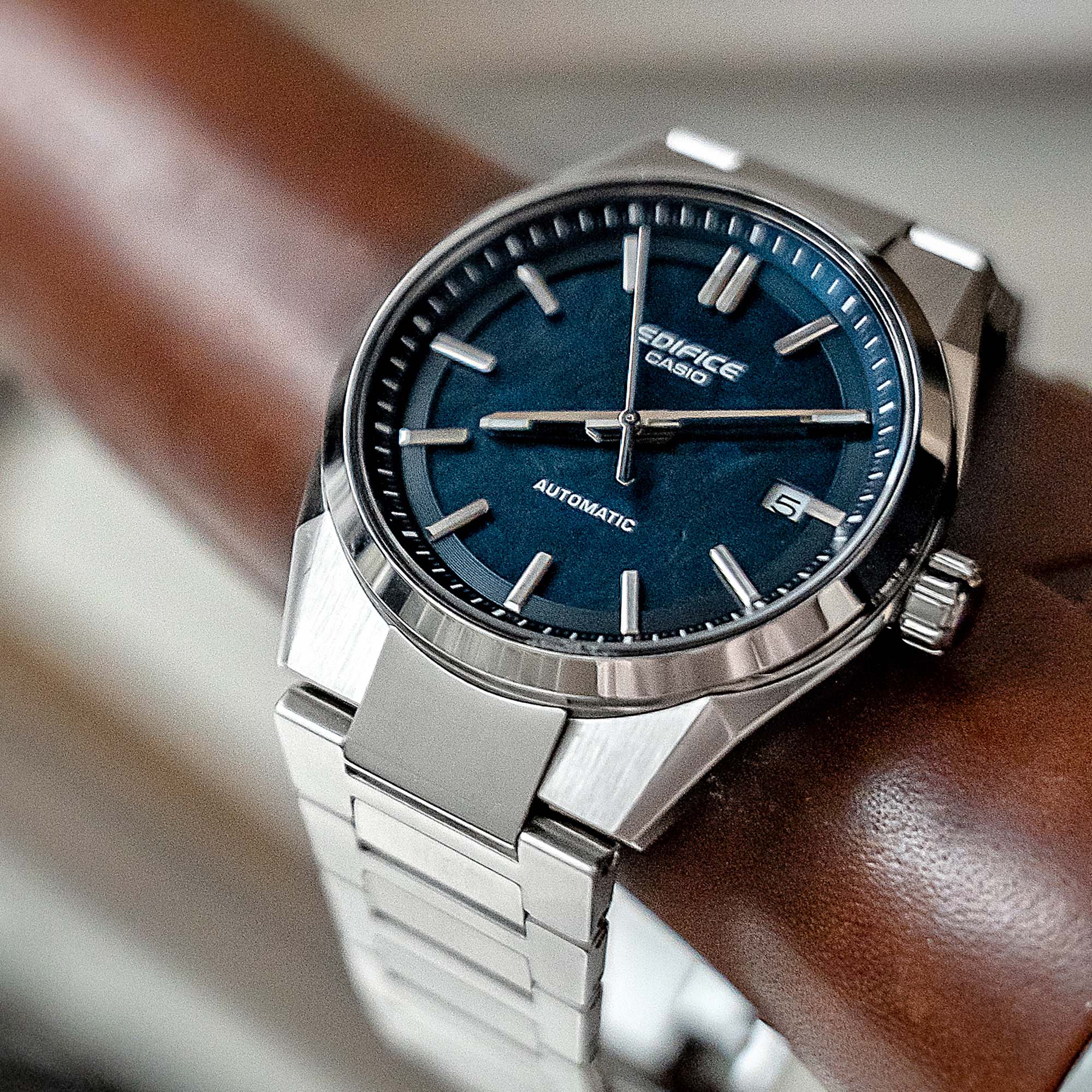
2. EDIFICE EFK-200
The EDIFICE EFK-200 combines mechanical watchmaking with a sporty yet elegant design inspired by the world of motorsports and high-performance sports cars. Its forged carbon dial, featuring a distinctive marbled finish, gives each watch a unique appearance. The EFK-200 is an appealing choice for men looking for a sporty automatic watch with distinctive materials and high-quality craftsmanship.
Movement: Automatic winding with additional manual winding capability
Power Reserve: Approx. 42 hours
Case Size: 43.6 × 38 × 11.9 mm
Crystal: Scratch-resistant sapphire crystal
Material: Stainless steel case and solid stainless steel band
Dial: Forged carbon with a unique marbled finish
Water Resistance: Up to 10 bar
Accuracy: −20 to +40 seconds per day
Additional Functions: Date display, stop-seconds function, analogue three-hand display
3. EDIFICE EFK-110
The CASIO EDIFICE EFK-110 combines the mechanics of an automatic watch with practical features for everyday use. Its Japanese-made automatic movement offers a power reserve of approximately 42 hours and can also be wound manually when needed. A sapphire crystal protects the dial, while water resistance up to 10 bar makes this watch a versatile everyday companion. The transparent case back allows you to watch the mechanical movement in action. The EFK-110 is an appealing choice for men looking for a functional automatic watch with a classic display.
Movement: Automatic winding with additional manual winding capability
Power Reserve: Approx. 42 hours
Case Size: 43 × 38 × 11.8 mm
Crystal: Scratch-resistant sapphire crystal
Material: Stainless steel case and stainless steel band
Dial: White dial with a subtle textured finish, created using a special electroplating technique
Water Resistance: Up to 10 bar
Accuracy: −20 to +40 seconds per day
Additional Functions: Date display, stop-seconds function, analogue three-hand display