















A Developer’s View on 60 Years of Casio Calculators

Masayuki Hagata joined Casio in 1967, just two years after the company’s first electronic desktop calculator, the 001, went on sale. He then worked on development for the epoch-making Casio Mini, a calculator that went on to sell one million units in just 10 months following its release in 1972. We sat down with Mr. Hagata to discuss Casio’s history in the calculator business over the last 60 years. Mr. Hagata has worked on many calculator models throughout his tenure at Casio. He shared his thoughts on topics ranging from the Casio Mini, which was born from the concept of the “Ultra Calculator”, as well as his unceasing interest in creating new products.
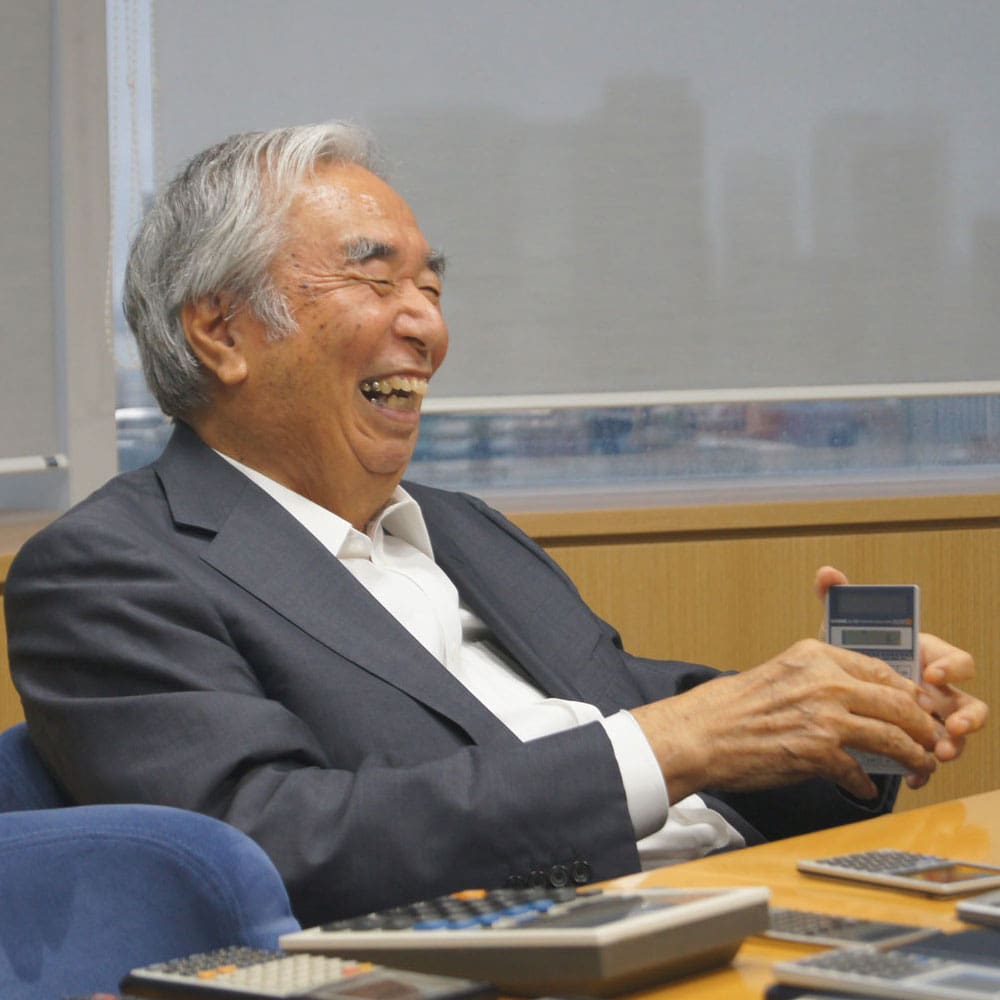
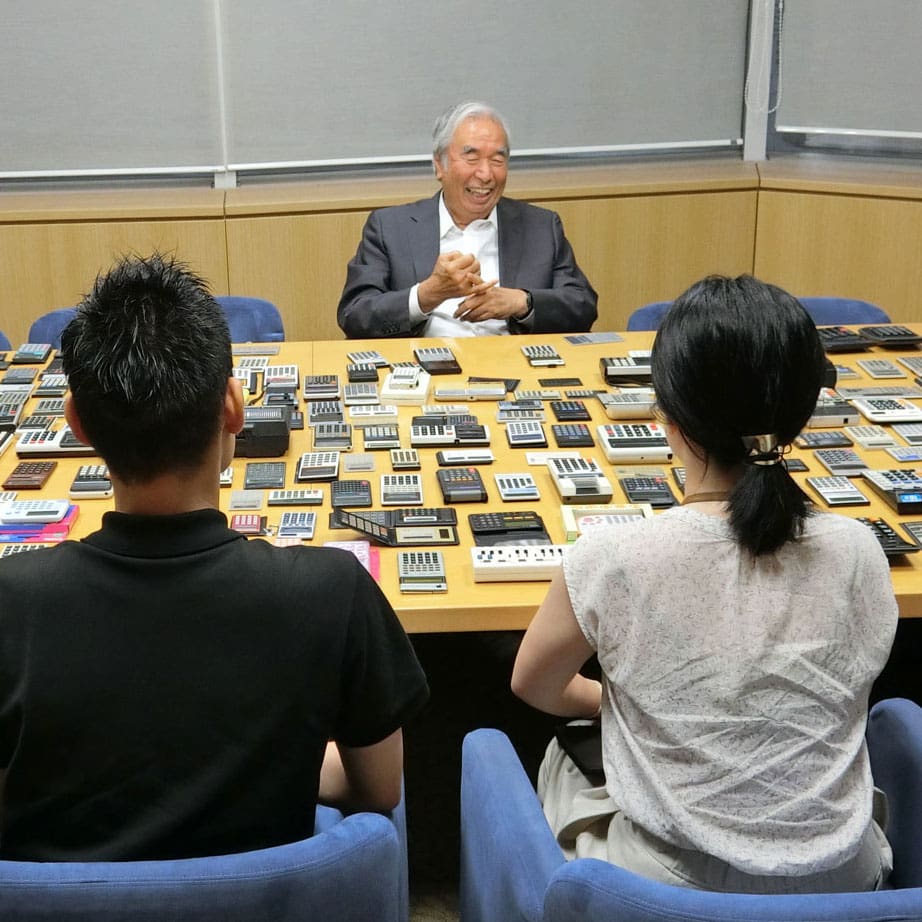
There’s nothing more interesting than being able to design and create new products yourself.
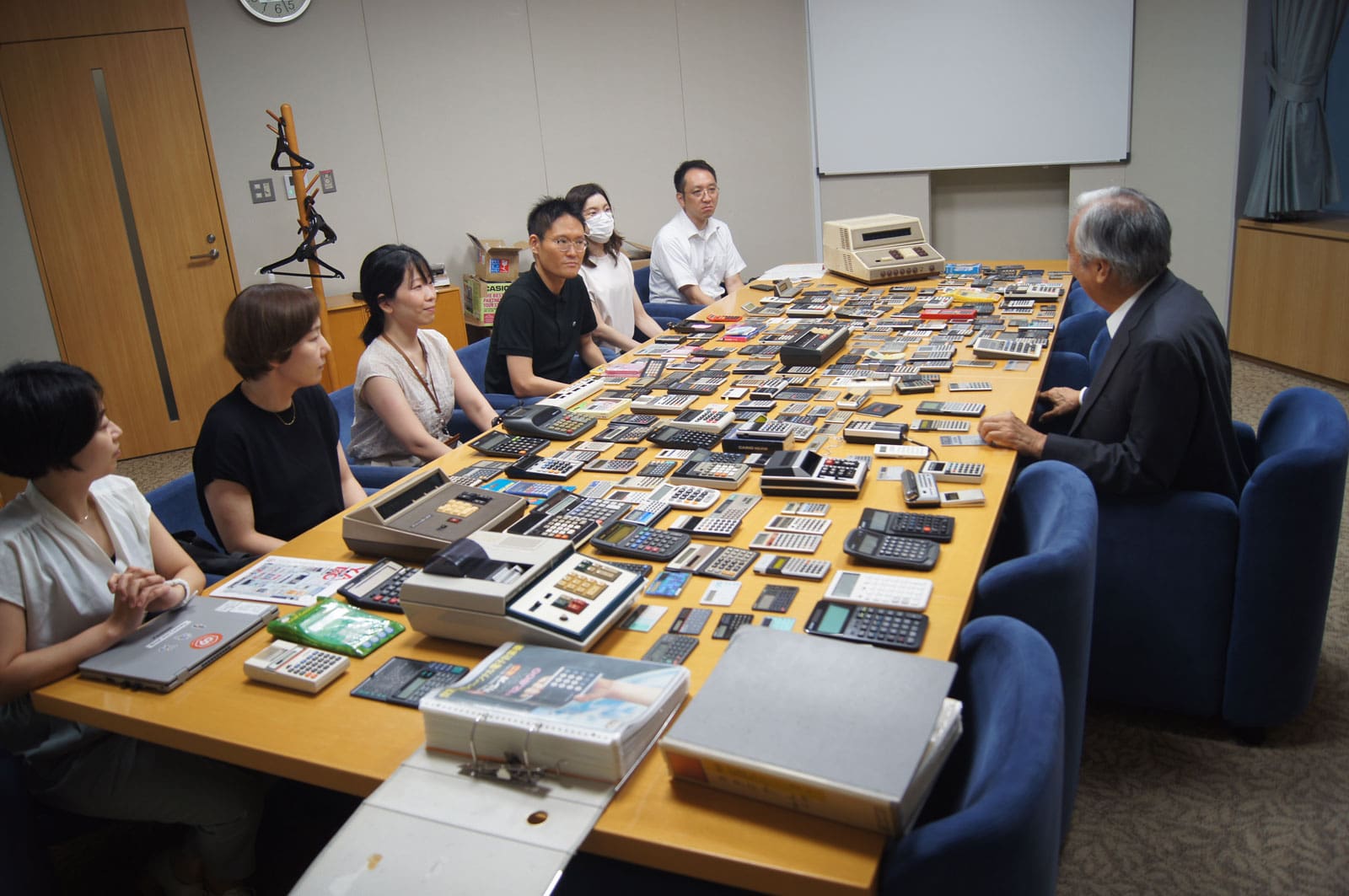
Interviewer: You’re still actively developing now, but how did you first become interested in this kind of work?
Hagata: It was 1966. As a fourth-year student, I had to pick what courses to take for my electrical engineering degree. The university was offering a course on computing, and at that time the computers were really huge. Not many people were studying computers in Japan then, but I really liked them. So the computing course looked really interesting to me, and I picked that.
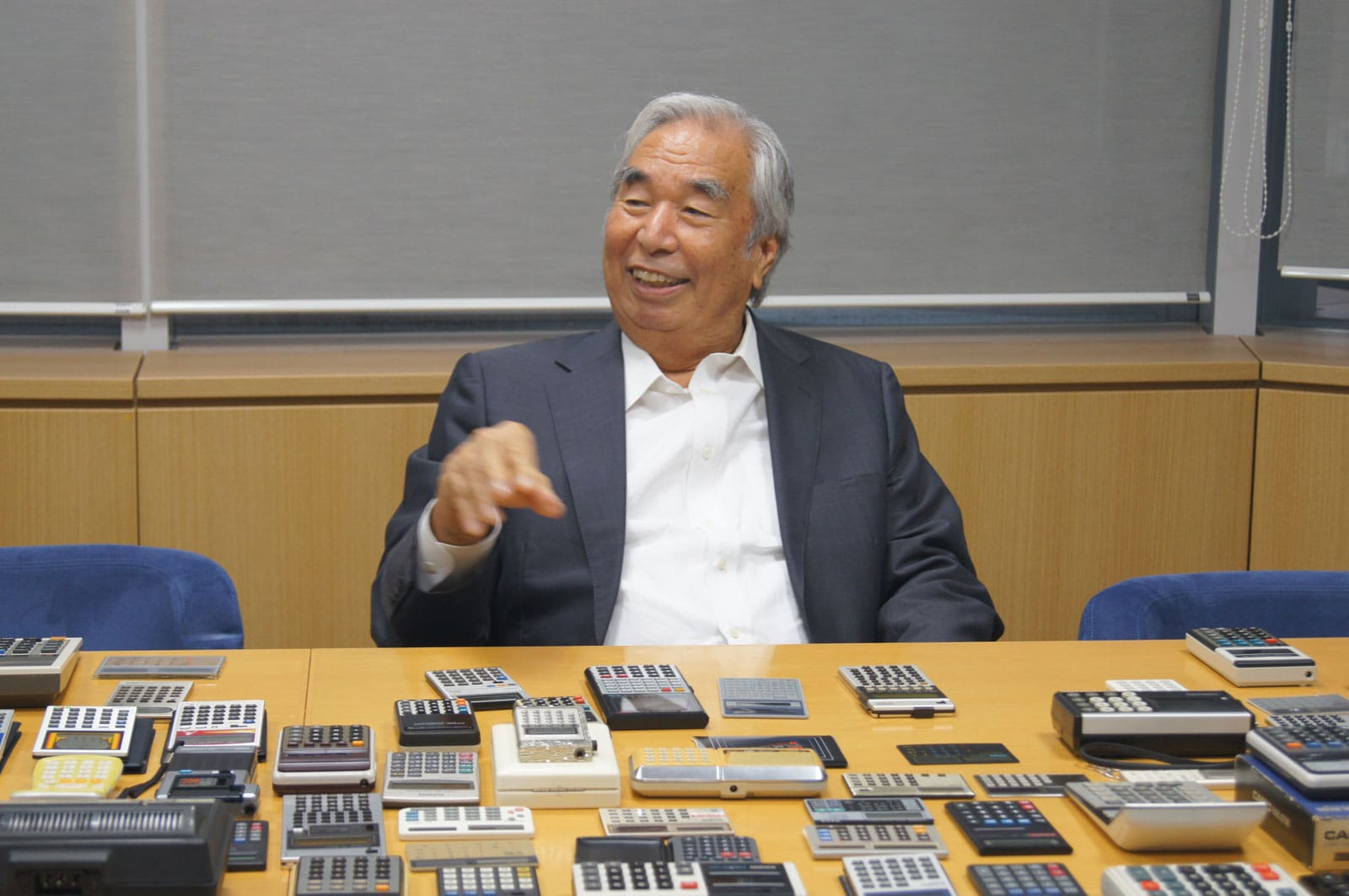
Interviewer: Then you went on to join Casio, right?
Hagata: That’s right. I joined the company in 1967. So, Casio’s first desktop calculator, the 001 [released in 1965], would have already been out by then.
When I joined, Casio had already progressed to electronic calculators, and was no longer producing its relay calculators from before that, which were invented by Toshio Kashio. [Toshio Kashio was an inventor and the second-eldest brother among the company’s four sibling founders. Relay calculators used relay elements that were switched on and off via electromagnets.] We did still have to provide maintenance to our existing relay calculator customers, though. I went to a class on this, and saw a relay calculator there. I thought it was amazing! One person thought up an algorithm, and built a calculator by using relays. The algorithm was one that used base-2 and base-5 calculations, like an abacus.
When I first joined the company, I was put to work in development right away. I helped out the engineer who was in charge of the 120 for about a year, and then the 152 [released in 1968] was the first model that I was in charge of developing.
The 120 was the first calculator to use an integrated circuit instead of the transistors that had been used up to that point. We even described it in the catalog as an “IC abacus for the space age”!
The abacus was once the only calculation device that people had in Japan.
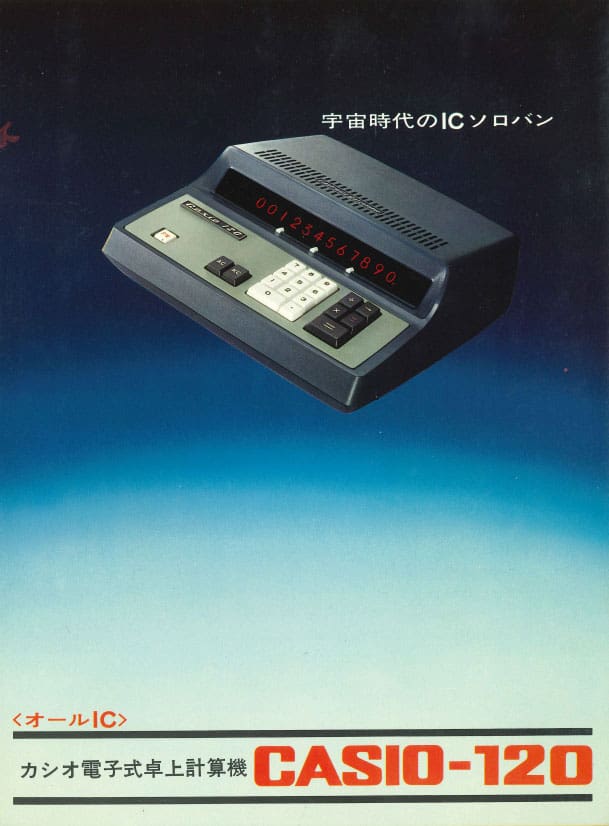
120 (1968)
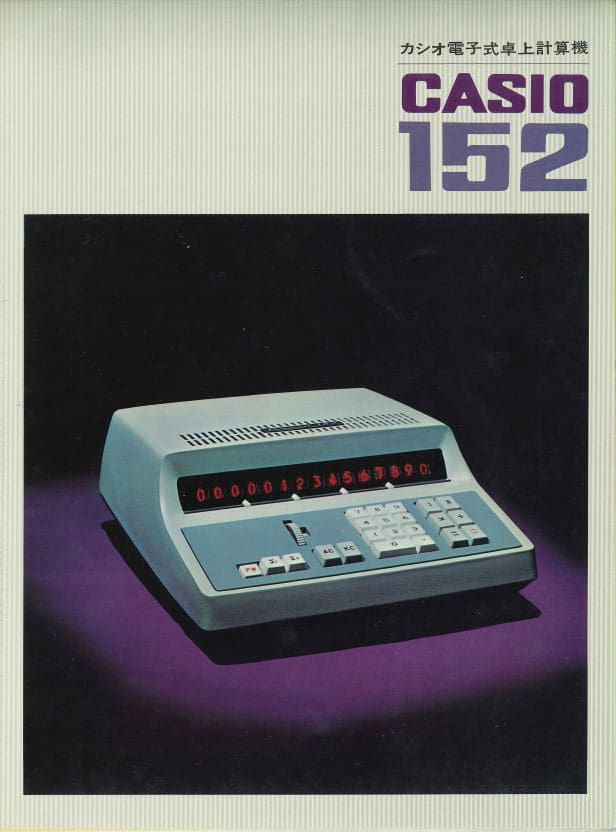
152 (1968)
Hagata: No matter how much I learned in school, I didn’t have the chance to actually create something. Joining Casio was so interesting to me, because nothing compares to being able to design and create new products yourself.
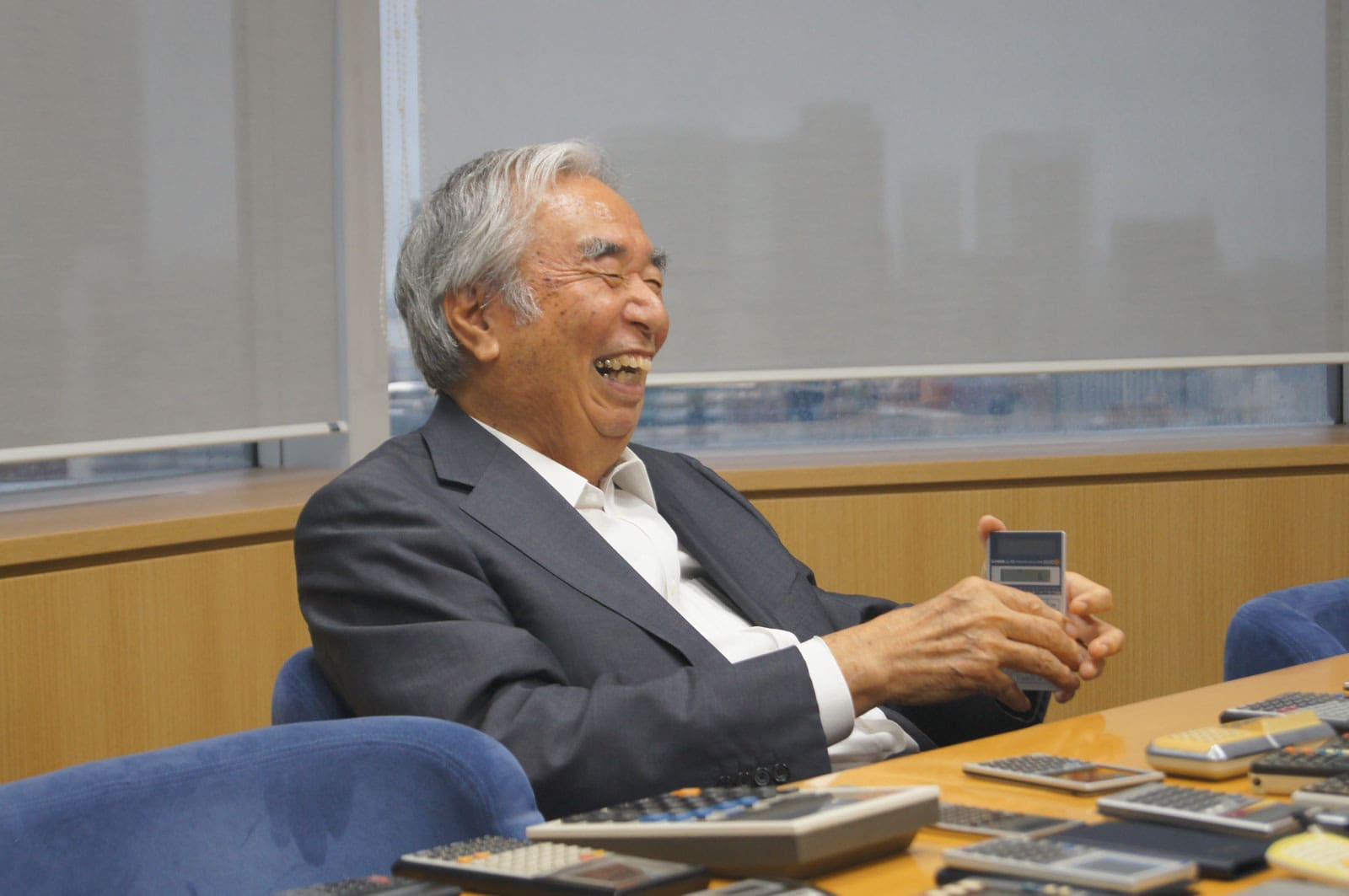
Hagata: When you’re developing computing devices, it’s easy to fall into the trap of thinking that computers can do anything. LSI technologies, which were like the brains that ran the calculators, were developed later and made many new things possible, but even at that time we were thinking about what was possible by using algorithms.
The AS-A was the first model that used a circuit that I developed for LSI. It had an oblong design, which made it look kind of like an abacus, and in fact the model name “AS” that Toshio Kashio chose was inspired by the word “abacus” itself. After that it felt like we made many revolutionary products that all started from that horizontal design.
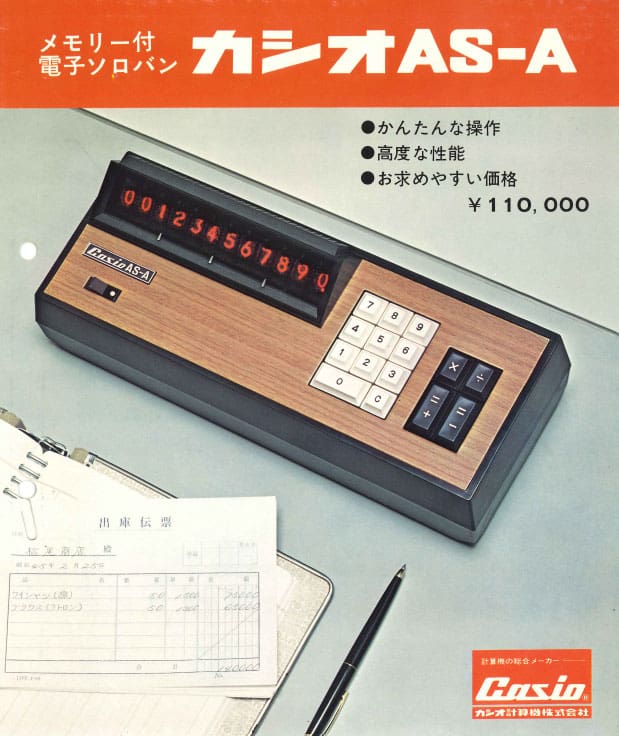
AS-A (1969)
Thinking is all you have to start with when you create something from nothing. There’s no other way to describe it. (Casio Mini)
Interviewer: Tell us about the Casio Mini, which was released in 1972. You designed the circuits and algorithms of the Casio Mini. How did development get started?
Casio Mini: Released in 1972. The Casio Mini featured a slim and lightweight body for easy portability. Reducing costs to consumers was a major focus of development, with this model achieving a price of 12,800 yen, a revolutionary reduction to just one-third the typical cost of calculators up to that point. The product was a major hit, selling one million units in just 10 months and achieving lifetime sales of 10 million units. The Casio Mini was responsible for the Casio brand being associated with calculators worldwide. In a market where calculators were once sold for use only by companies, the Casio Mini paved the way for the calculator finding regular use in individual households. With the Casio Mini spearheading this widespread adoption, LSI technologies were required in large quantities, leading to the evolution of both calculators and LSI in parallel.
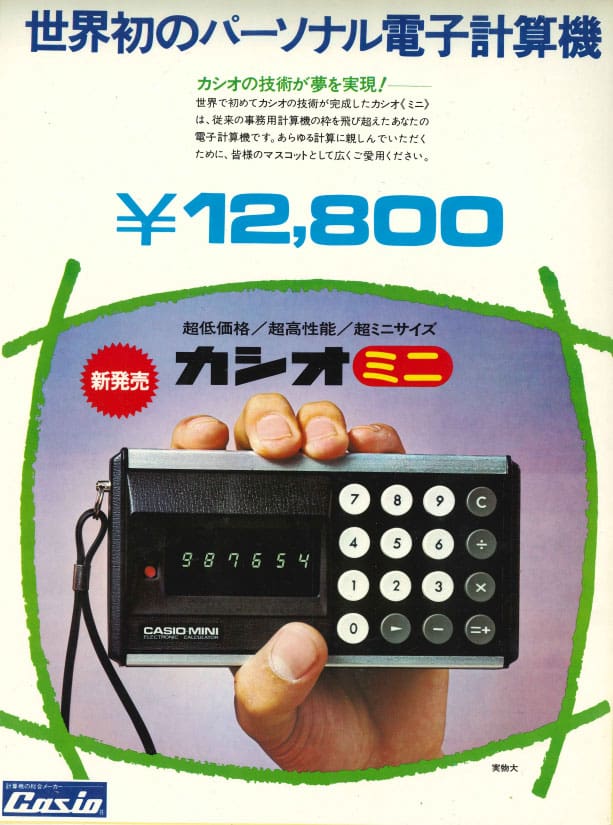
Casio Mini (1972)
Hagata: Even inexpensive calculators at the time were about 38,000 yen. When we talked about making a 10,000 yen calculator, my boss wrote “Ultra Calculator” on the blackboard.
I was beginning work on a scientific calculator at the time [the fx-1, Casio’s scientific calculator released in 1972], so when I was assigned to work on the 10,000 yen “Ultra Calculator,” I wondered how to move forward.
I thought that maybe we could hit 10,000 yen if we reduced the number of LSIs to just one [it was typical at the time for calculators to use multiple LSIs] and used a four-digit display. But then that would mean you would only be able to compute values to the thousands place, and that wouldn't be of much use to anyone. We ended up using a six-digit display, thinking that, at the very least, you would want to calculate numbers up to about one million yen.
Using a six-digit display is fine, but using multiplication will exceed those six digits in no time. So we made it possible to press the double-length button to show the numbers in positions beyond the first six digits.
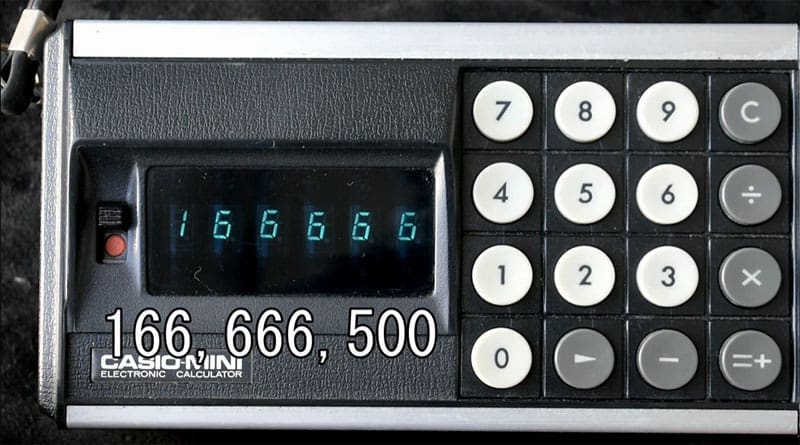
Users could press the double-length button [the button with a triangular shape] to show digits beyond the first six.
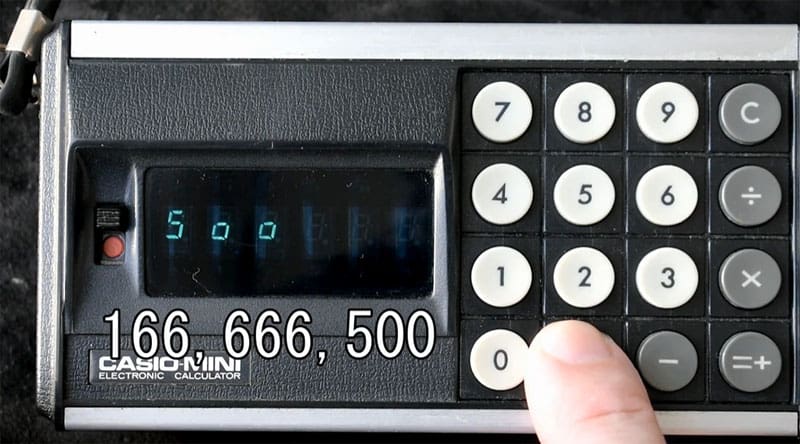
The display toggled to show numbers from the seventh digit onward.
Hagata: Another feature was the lack of a decimal point. All calculators before that had decimal points. Using a decimal point made the circuitry quite complicated. But if we got rid of the decimal point, we could make a calculator with only a single chip, so we did. But a calculator that can't perform 1 ÷ 3 wouldn’t be a real calculator, would it? We worked really hard on finding a solution to this, which was to simplify the circuit by having the double-length button show the place values to the right of the decimal point (like .33333) whenever you pressed the button.
Interviewer: Using the double-length button as a way to exceed the six-digit limit was a very novel approach. How did you come up with it?
Hagata: Well, it just comes down to thinking things through. Thinking is all you have to start with when you create something from nothing. There’s no other way to describe it. We already had eight-digit calculators at the time, so we didn't want to do that. Basically, we just didn’t feel like repeating things that others had already done. An eight-digit calculator was 29,800 yen then. So that wasn’t anything interesting or out of the ordinary. Our breakthroughs come when we recognize the walls we have to get past. When our boss said we were going to make a 10,000 yen “Ultra Calculator,” we thought, well, if it’s only 10,000 yen, anyone would be able to get one!
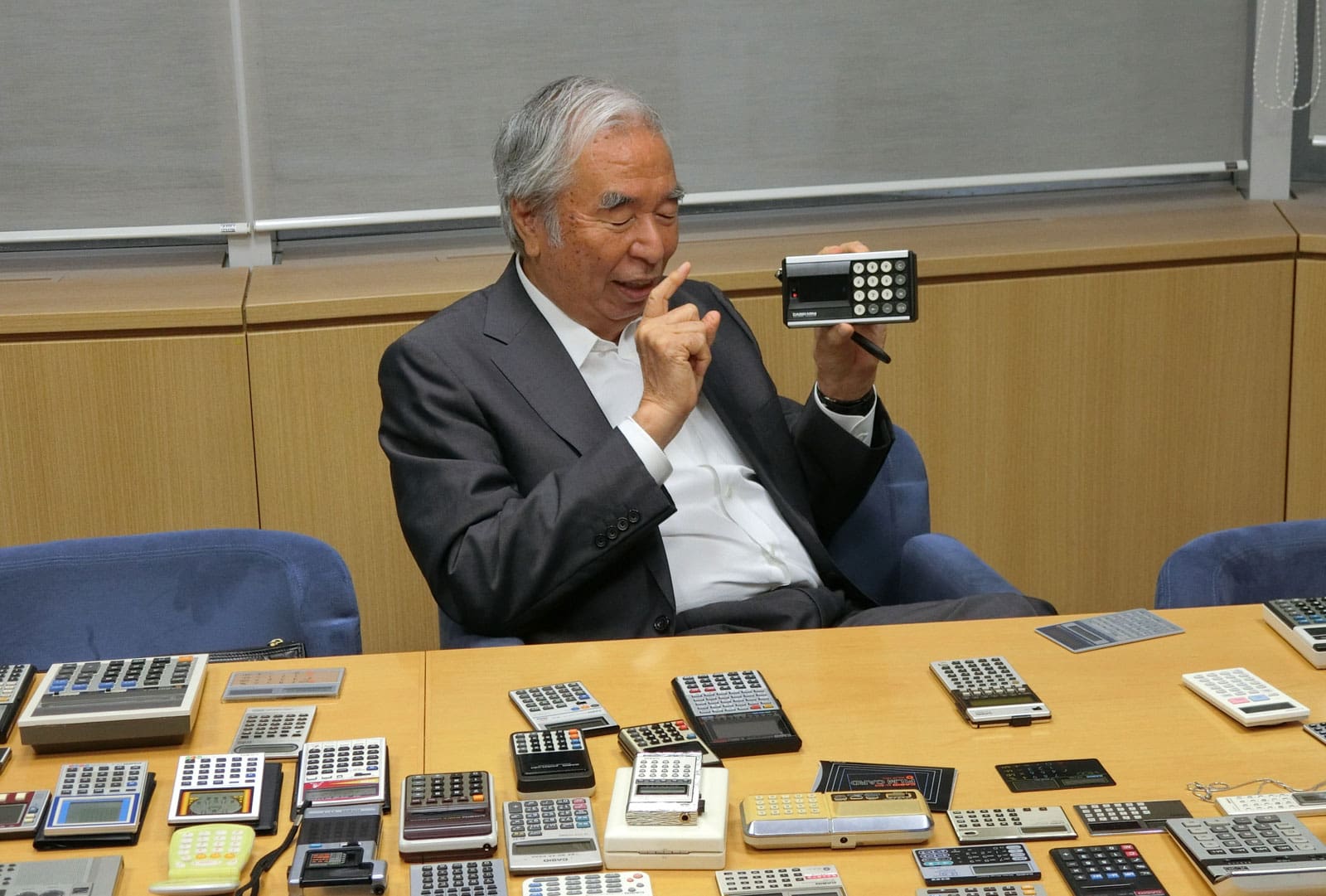
Hagata: We also were very particular about the calculator being able to run on batteries. An eight-digit display uses a lot of power, but on the other hand, a four-digit display is not really useful as a calculator, either. These were the trade-offs we looked at when we chose six digits.
I think it was February when we asked our partner company to create the LSI from our drawings. I was so nervous in anticipation, waiting for the LSI to be finished. If I had put even one line in the wrong place, it would have ruined everything, right? We didn’t have simulators then, either, so I was really nervous about it.
Then Yukio Kashio [an advisor and youngest brother among the company’s four sibling founders] built a mechanism for us. We really struggled to the make plate-spring switches, too. If we hadn’t had Yukio Kashio’s circuits, with their mechanical and low-power design, we wouldn’t have succeeded.
Interviewer: What did you think when you saw the completed Casio Mini?
Hagata: I felt that we succeeded in making something that had never existed before. I think the biggest thing was the fact that it was battery-powered. Calculators up to that point had power cables, so people couldn’t carry them around.
I felt that having a portable calculator was very appealing.
It just reinforced my thinking that calculators would never become widespread if they couldn’t be used anywhere. And to achieve that, we had to use batteries.
We had to allow people to use the calculators for several hours on battery power, so we focused on achieving a low-power design as much as we could. One of the techniques we used was displaying the numeral “0” at a smaller size than the other numerals.
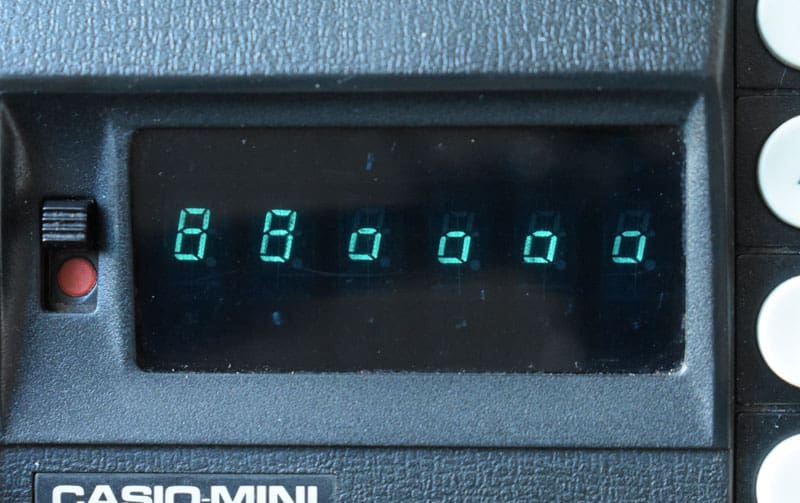
Reducing the size of the numeral “0” resulted in less power being used to light the display.
Hagata: One of the greatest joys for a developer is seeing someone use something that you created. At the time, I could turn on the TV and by chance see someone doing something like surveying mountains. And you know what? They were using the Casio Mini! No one had been able to use calculators outside up to that point, so when I saw people using the calculators to do things like that, I was sure that they would sell well.
Once, when I went on a business trip to Italy, I took out the Casio Mini at a restaurant, and everyone crowded around me. They all wanted me to sell it to them!
No one had been able to take calculators with them and use them anywhere like that. The Casio Mini was truly an epoch-making product with a major impact.
And I think that being inexpensive would not have been enough. Having it run on batteries was the key.
Interviewer: When the Casio Mini went on sale in 1972, it was a big hit, selling one million units just 10 months after launch. (The Casio Mini series of calculators went on to reach 10 million units sold.)
Hagata: We were used to seeing calculator orders come in for about 1,000 units a month back then, so I was surprised to hear that we were making 100,000 of these.
The Casio Mini was hugely successful in the United States. The exchange rate at the time came out to $49.95, which was quite inexpensive.
Competition was so fierce in the industry then that we called it the “calculator wars” with a variety of the manufacturers making their own calculators. But when the Casio Mini came out at such a low price, many of them bowed out.
Interviewer: You’ve been involved in the development of many different products since the Casio Mini. What do you think the legacy of the Casio Mini is today?
Hagata: When I think of the Casio Mini, I think it’s an example of us successfully implementing an interesting idea. We didn’t want to do the same things that other people were doing. We certainly wouldn't have been able to make a calculator that cost 12,800 yen if we designed it the same way as someone else’s. How do we break through what’s here now? I felt that we achieved a true breakthrough.
You have to get past whatever walls you encounter.
We didn’t think these would be big sellers. But one thing we did know was that we had to always be making the greatest, most cutting-edge calculators.
Interviewer: At the same time that you were developing the Casio Mini, you were also working on what would become Casio’s first scientific calculator, the fx-1, which was released in 1972.
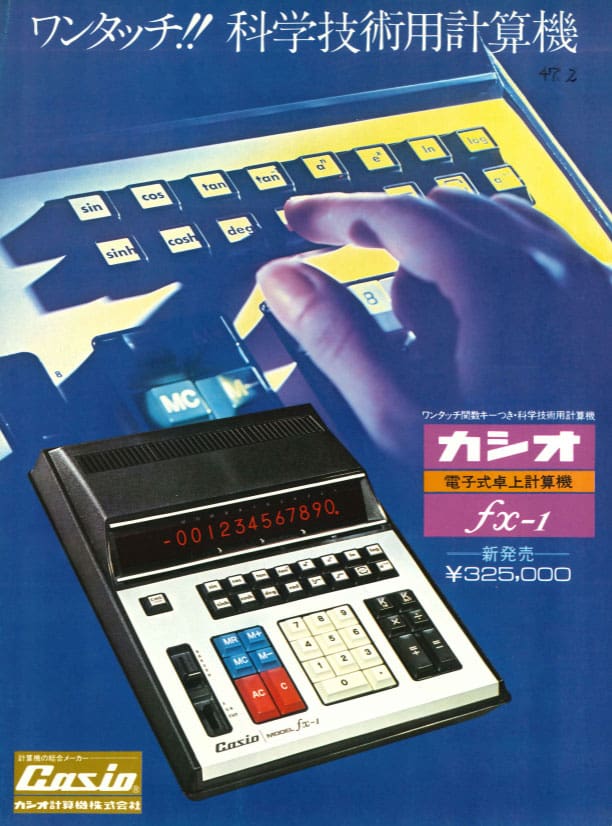
fx-1 (1972)
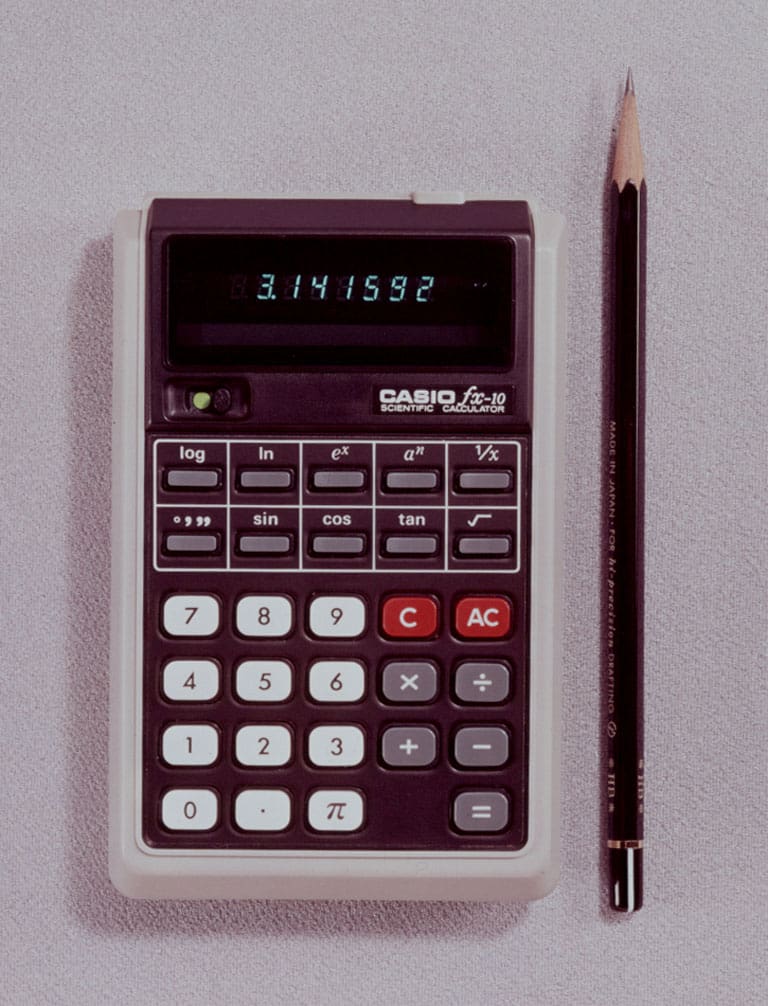
fx-10 (1974)
Hagata: The fx-1 [released in 1972] was our first scientific calculator, and it cost 325,000 yen. We thought this was too expensive for students, so we made the fx-10 [released in 1974 for 24,800 yen] so that students could afford it. We sold this calculator to students at technical high schools, creating a pathway for selling Casio products to schools. This helped us sell other products beyond scientific calculators to schools as well. The fx-10 was very important in this.
Before function-calculation devices were available, science and engineering students had to use a slide rule [an analog calculation tool]. Scientific calculators cost 325,000 yen at that point, so when the fx-10 came along, the price to get one of these calculators suddenly dropped to just 24,800 yen. The fx 10 was seen as a major reason for a big drop in prices across the industry
Interviewer: So many different kinds of calculators were made after the Casio Mini!
Hagata: One thing that comes to mind is the competition we had with other companies to keep making smaller calculators.
First, one company made a calculator that was the size of a small notebook. They beat us to that. So we asked, what can Casio do now? Our answer was to make a calculator the size of a credit card.
We came out with the LC-78, which took its name from its release year of 1978. This was our credit-card-sized calculator. At the time, we made a commercial where someone was holding the LC-78 in their hand, and they would make it spin just by blowing on it. We ultimately arrived at the SL-800 later.
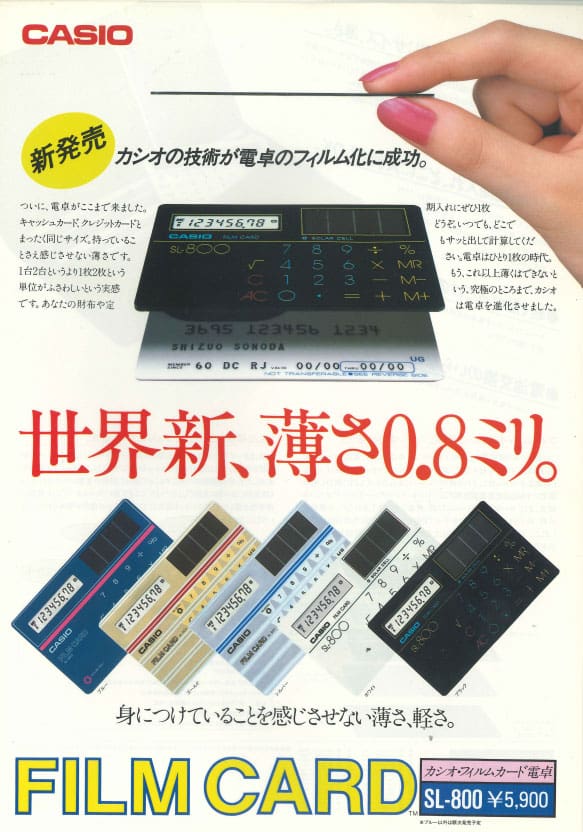
SL-800 (1983)
SL-800: Released in 1983. Using a film-like approach to the electronic components, the SL-800 achieved a thickness of just 0.8 mm and a weight of 12 grams, making it the world’s thinnest calculator in a credit-card size. This model was an amalgamation of the imagination and technical prowess of Japan and was considered to be the ultimate in portable calculators..
Hagata: The SL-800 was expensive [5,900 yen at the time], so I didn’t think it would sell particularly well. But we were the top calculator manufacturer, so we felt like we had to always be making the greatest, most cutting-edge calculators.
Every day, a new product. That’s the Casio way.
Casio Computer has to make computing devices, it’s only natural. When you look inside a watch, there’s a computing device in there. Casio expanded into a lot of different business areas beyond calculators, such as watches, musical instruments, cameras, and mobile phones. So, with a name like “Casio Computer,” we thought about dropping the “Computer” part of it and changing the name to just “Casio.” But we decided that all of our products have computing devices at their core, so in the end we decided to keep the “Computer” in the name. We’re Casio Computer, because Casio Computer’s various products are all made with computing technologies.
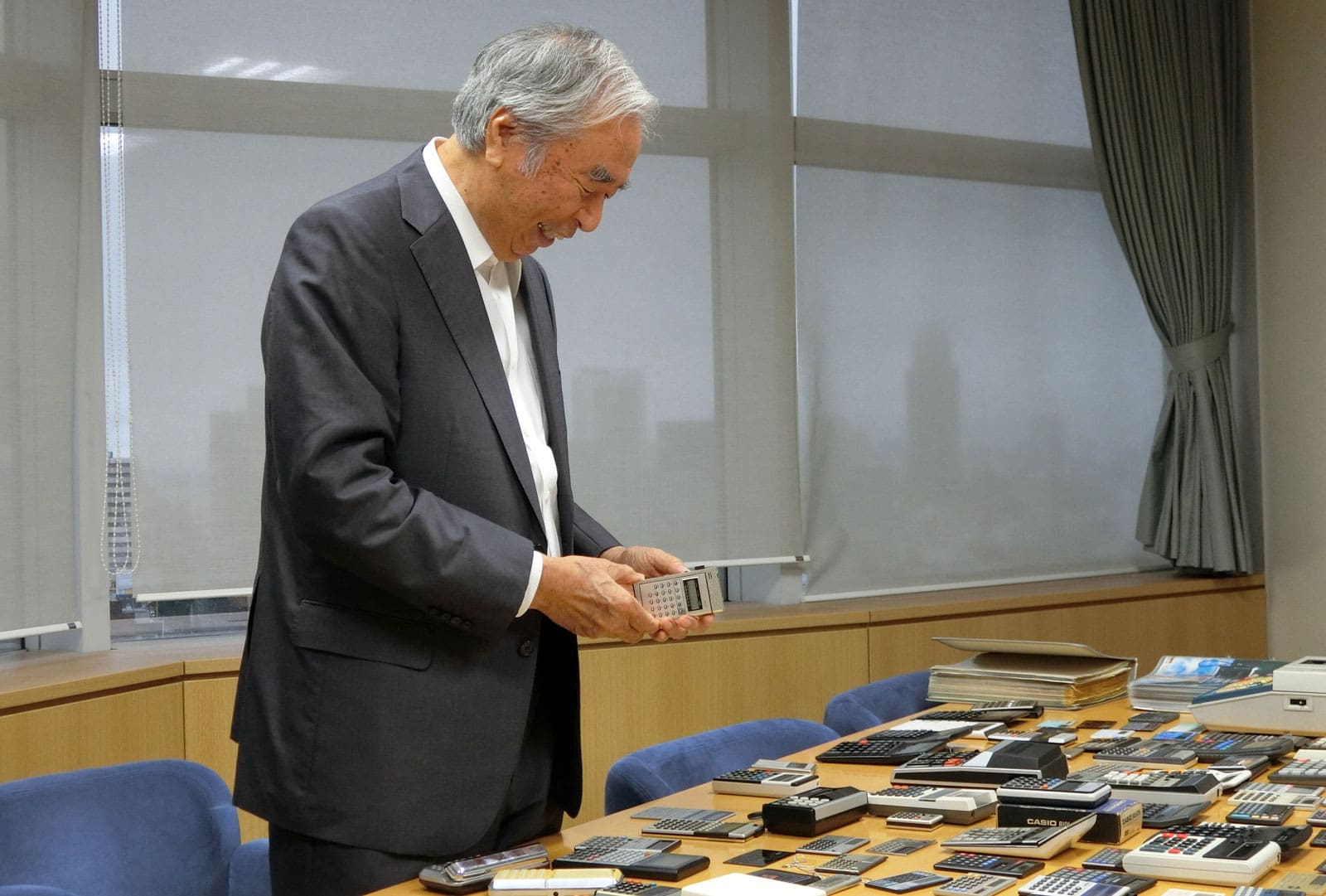
Interviewer: For our last question, we would like to ask, what do you personally think is the Casio way of doing things?
Hagata: Every day, a new product.
I’d say that’s the Casio way.
Everyone expects Casio to be the company that is always creating new things, and I hope that Casio can be that kind of company in the future, too.
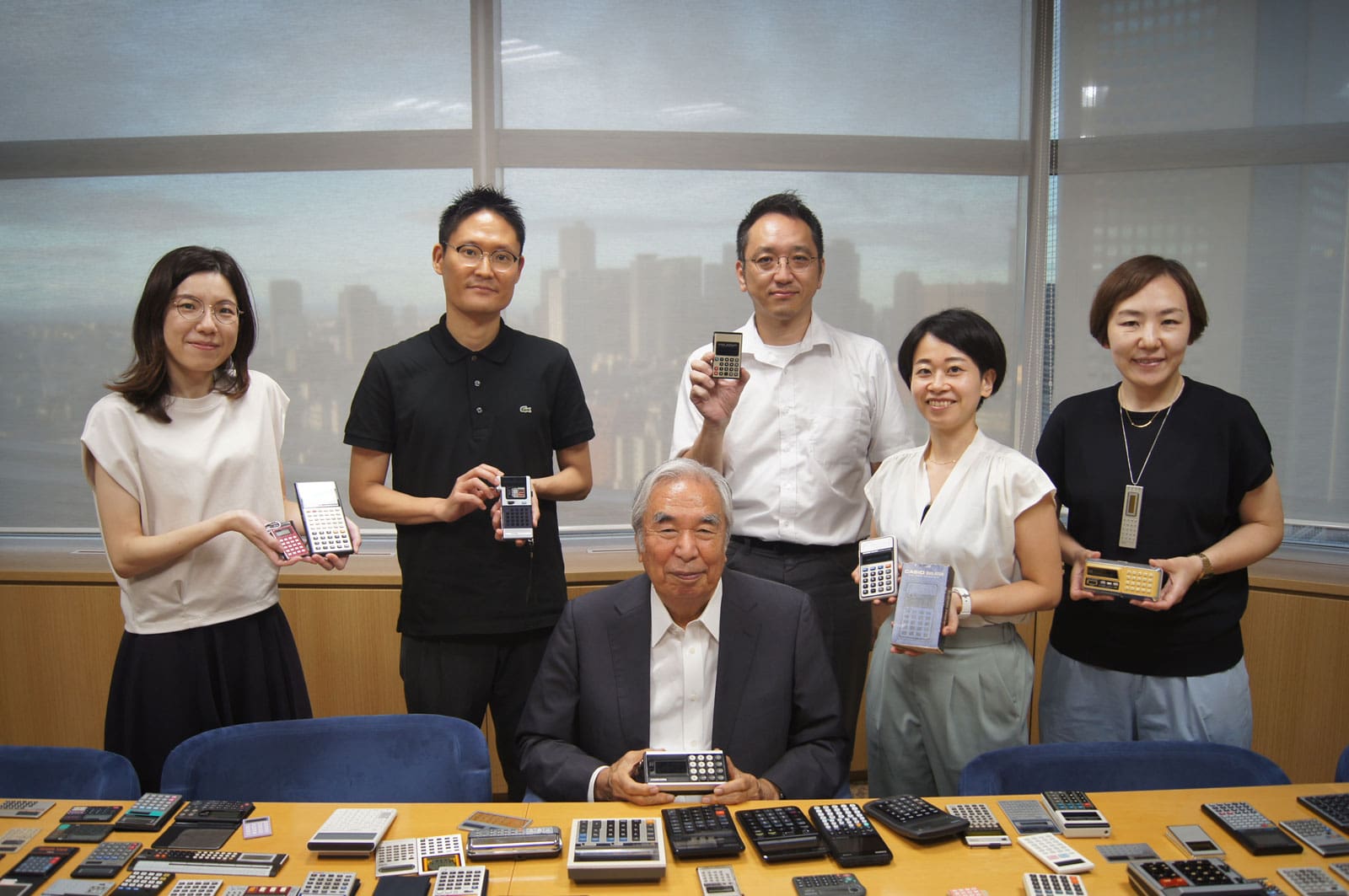
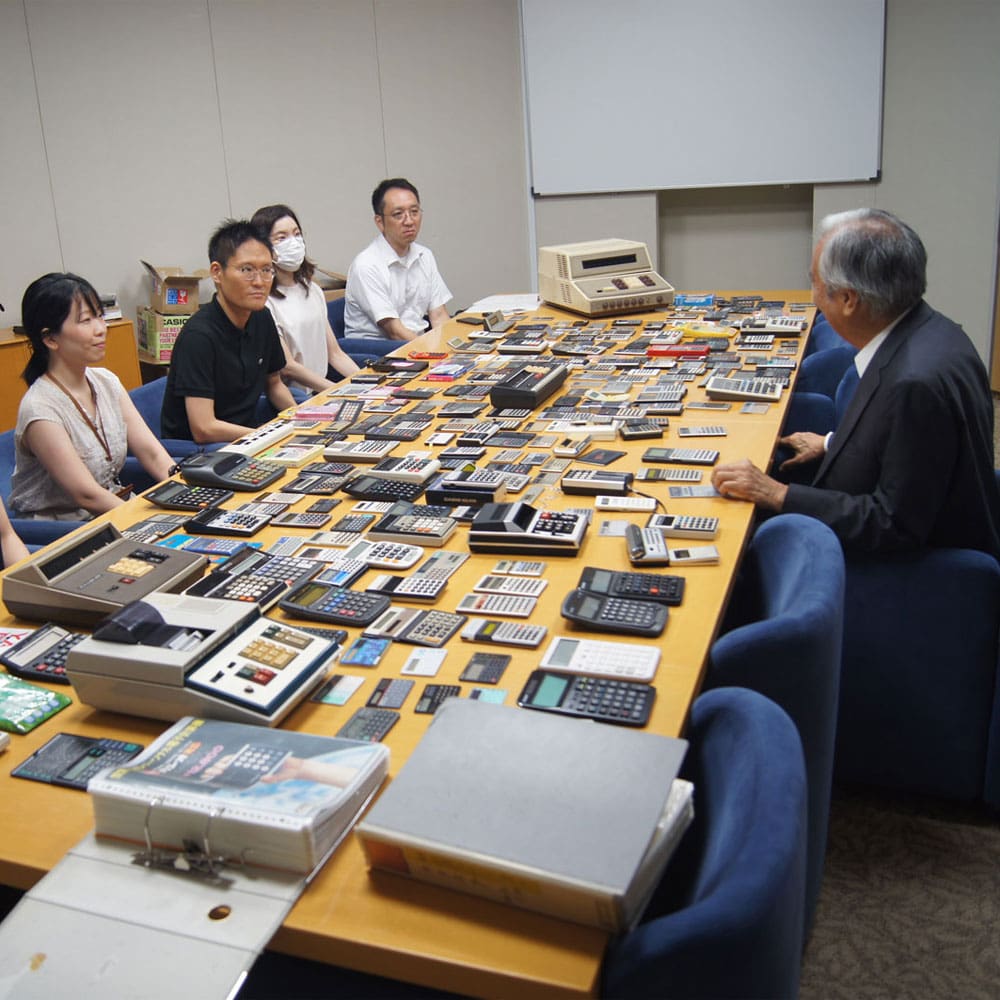
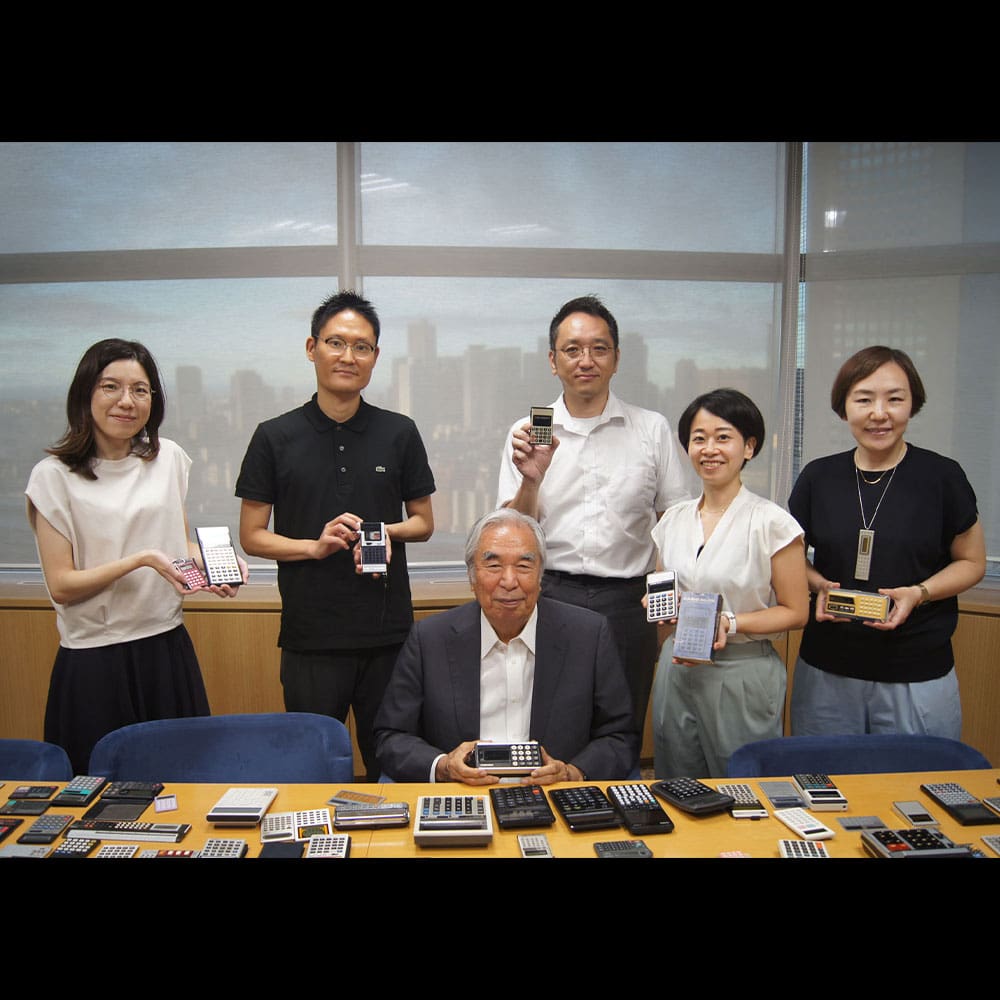
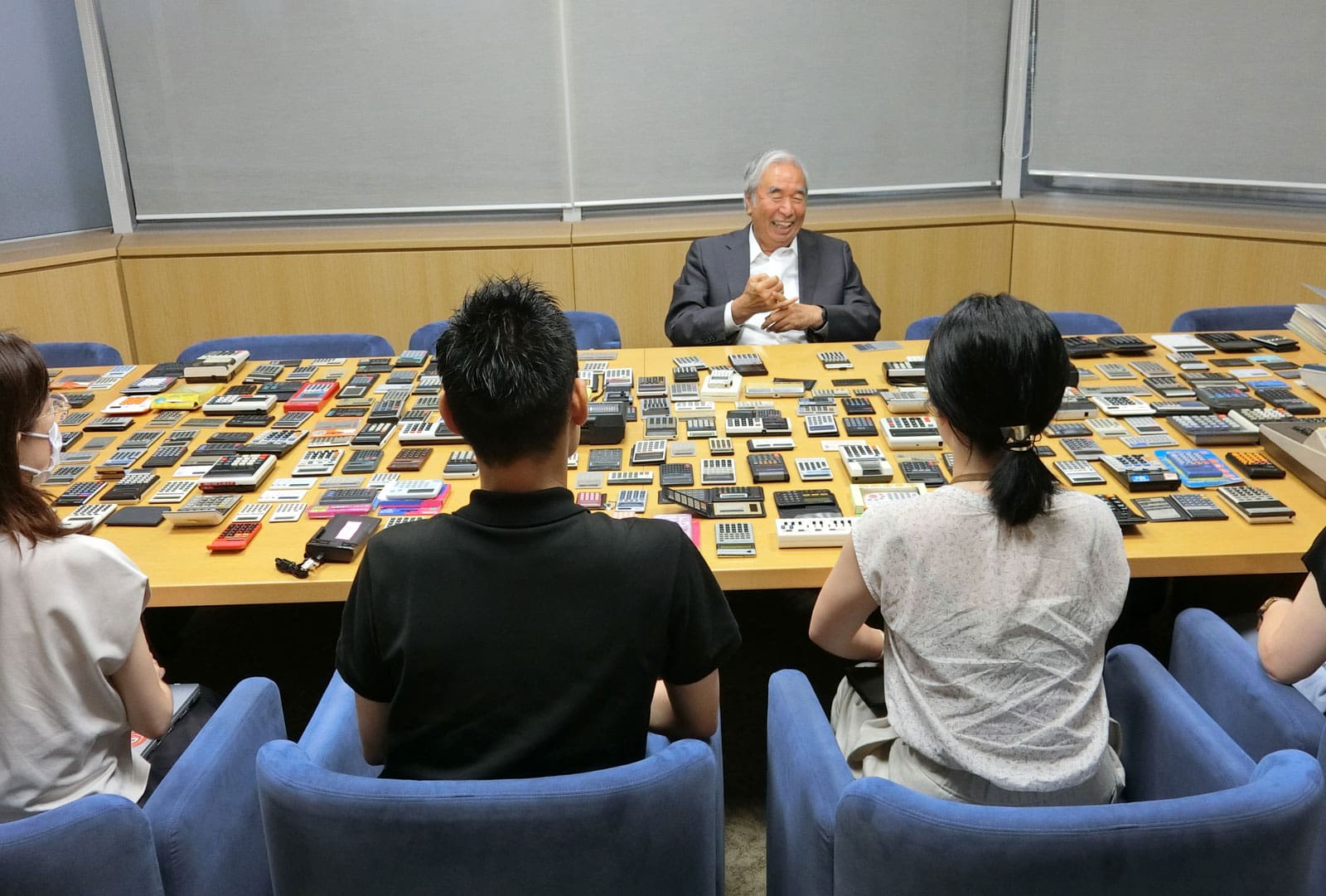
Members of the Calculator 60th Anniversary Project with Mr. Hagata